Stress Echo and Exercise Bicycle Test - Cardiac Stress Testing at Apollo CVHF
For Patients Who Cannot Use a Treadmill - An Alternative Way to
Assess the Heart Under Stress
Not every patient can walk briskly on a treadmill. Patients with arthritis, back pain, leg problems, or balance difficulties may be unable to perform a standard treadmill stress test. The exercise bicycle test (bicycle ergometry) and stress echocardiography offer alternative ways to stress the heart in a controlled, monitored setting, providing the same diagnostic information as a treadmill test, without the need for walking.
What Is the Exercise Bicycle Test?
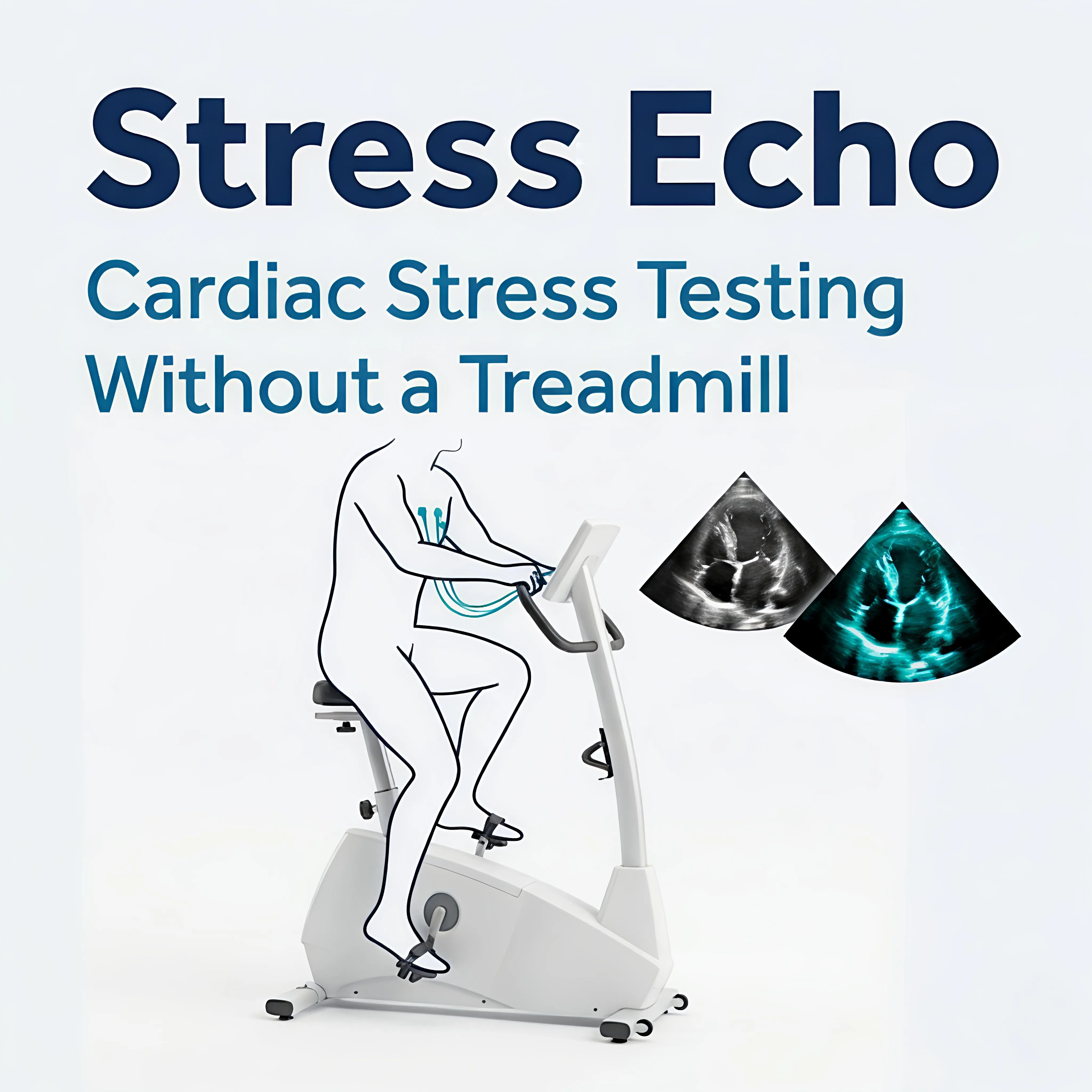
The exercise bicycle test uses a
stationary exercise bicycle. You pedal against increasing resistance, which
progressively raises your heart rate and the demand on your heart just as a
treadmill raises demand through speed and incline. Your ECG, blood pressure,
and symptoms are continuously monitored throughout.
The bicycle test is particularly
suitable for patients who cannot walk fast enough to achieve an adequate heart
rate on a treadmill, but who are able to pedal. The sitting position also makes
it more comfortable for patients with balance or mobility concerns.
What Is Stress Echocardiography?
Stress echocardiography combines
cardiac ultrasound (echo) with a stress test. Echocardiographic images are
taken at rest and then immediately after peak exercise (bicycle or treadmill).
The cardiologist compares the two sets of images to identify areas of the heart
muscle that are not receiving adequate blood flow during stress, but which
appear normal at rest.
Stress echo is more sensitive than
a standard ECG-based stress test for detecting coronary artery disease,
particularly in patients where the resting ECG makes standard stress test
interpretation difficult, such as patients with bundle branch block or
patients on certain medications.
What Should I Expect?
ECG electrodes are applied to your
chest. Echocardiographic images of your heart are taken at rest. You then
exercise on the bicycle the resistance gradually increases. Immediately after
you stop, the echo images are repeated while your heart rate is still elevated.
The whole process takes approximately 45–60 minutes.
|
Wear
comfortable clothing. Fast for at least 3 hours before the test. Continue
your regular medications unless specifically advised otherwise by your
cardiologist. |