
Stentless PCI - Drug Coated Balloon (DCB) Angioplasty at Apollo CVHF, Ahmedabad
If you've been told you have a heart blockage, you may have heard about treating it "without a stent." This is real, and Apollo CVHF's cardiology team in Ahmedabad performs it extensively - but it isn't right for every blockage, and understanding how it actually works matters more than the promise of "no stent."
Medically reviewed by Dr. Sameer Dani, Chief Interventional Cardiologist, Apollo CVHF Hospitals - last reviewed September 22, 2026.
What Is Stentless PCI?
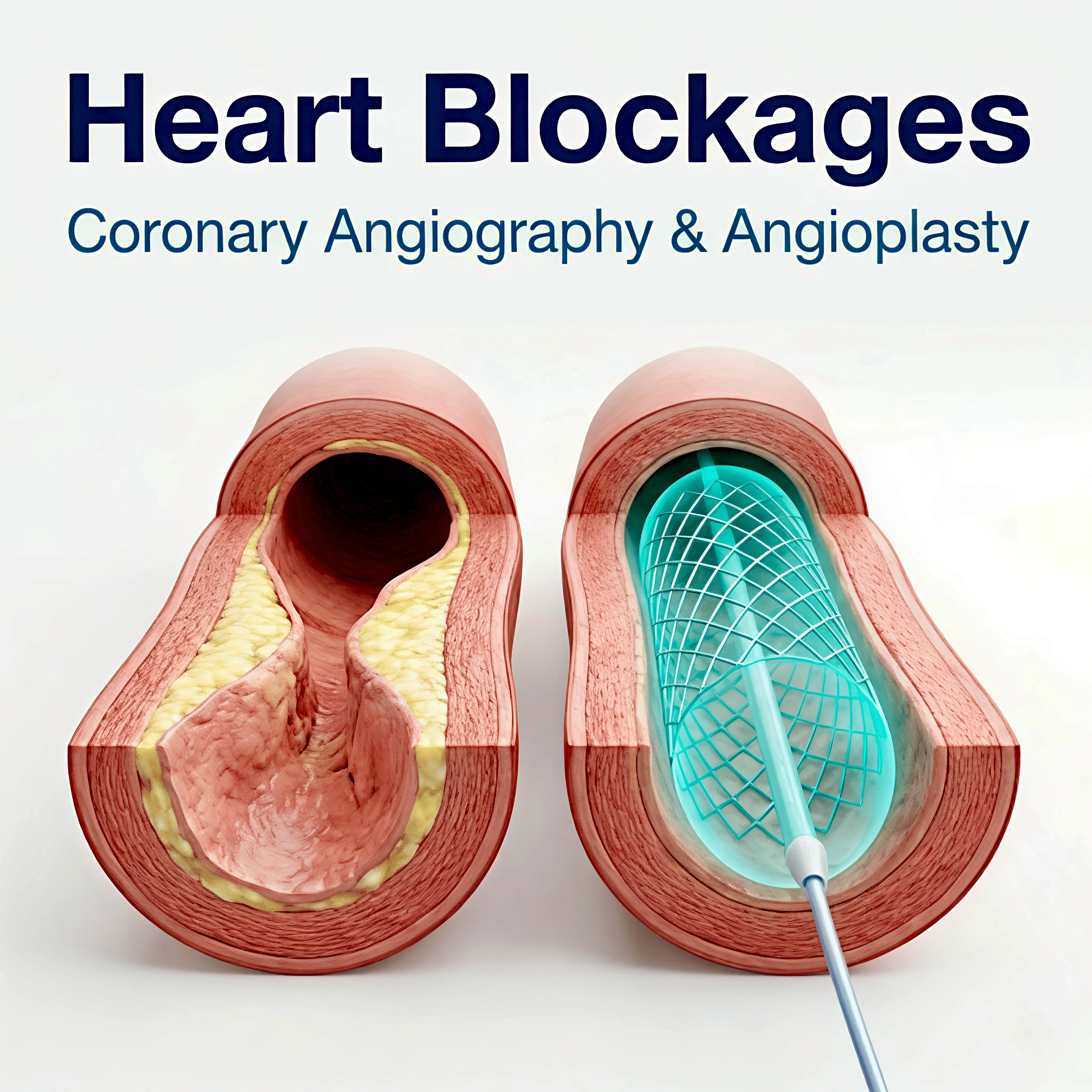
Stentless PCI - also called Stentless Angioplasty - refers to treating a blocked coronary artery without leaving a permanent stent behind. Drug-Coated Balloon (DCB) angioplasty is the principal technique used for this approach. DCB is sometimes also called a Drug-Eluting Balloon (DEB) - these two terms describe the same technology. The balloon is coated with medication, opens the artery, delivers the drug directly into the vessel wall, and is then removed.
This is different from a DES (Drug Eluting Stent) - a permanent metal implant, also coated with medication, that remains inside the artery. In short:
Stentless PCI / Stentless Angioplasty → performed using a Drug-Coated Balloon (DCB) → also known as a Drug-Eluting Balloon (DEB) → not the same as a Drug-Eluting Stent (DES), which is permanent.
How It Works - Leave Nothing Behind
When DCB May Be Considered
- In-stent restenosis (ISR) - a previously placed stent narrowing again; this is one of the most common reasons DCB is used, worldwide and at Apollo CVHF
- Small-vessel disease
- High Bleeding Risk (HBR) patients - because nothing permanent is left behind, DCB may allow a shorter course of dual antiplatelet therapy, which can be an important consideration for patients at increased risk of bleeding
- Bifurcation lesions - where an artery splits into two branches
- Chronic Total Occlusions (CTOs) - arteries that are completely blocked
- Ostial lesions - blockages located at the very origin of an artery, including select ostial LAD cases
When a Stent May Still Be Required
- Lesion preparation does not achieve an adequate result
- There is significant recoil (the artery narrowing back down after the balloon is removed)
- A flow-limiting dissection occurs (a tear in the artery wall)
- The vessel is very large (above 3.5mm in diameter) - DCB alone is generally not used above this size
- The blockage involves the left main artery - Apollo CVHF's team generally uses a combined DES + DCB approach for left main disease, rather than DCB alone
What to Expect - Procedure & Recovery
- Access site: through an artery in the wrist (radial) or groin (femoral) - your cardiologist will determine which is best for you
- Anaesthesia: local anesthesia with light sedation; you are typically awake during the procedure
- Duration: typically 30–90 minutes, depending on the complexity of the blockage
- Hospital stay: many patients go home the same day or after one night, depending on the case
- Recovery: most patients can walk within a few hours; your cardiologist will guide you on when it's safe to resume driving, work, and other activities
DCB vs. DES - Understanding Your Options
|
|
DCB (Stentless PCI) |
DES (Drug Eluting Stent) |
|
What it is |
A medicated balloon that opens the artery, then is removed |
A permanent medicated metal scaffold left in the artery |
|
Left behind afterward |
Nothing |
The stent, permanently |
|
Typically suited for |
ISR, small-vessel disease, high bleeding risk (HBR)
patients, and selected complex cases with good preparation |
A wide range of blockages, including many not suited to
DCB alone |
|
High bleeding risk (HBR) patients |
Often favoured - may allow a shorter course of
blood-thinning medication |
Generally requires a longer course of blood-thinning
medication |
Why Apollo CVHF
Apollo CVHF's interventional cardiology team performs 1,000+ DCB procedures every year, making it one of the highest-volume DCB programmes in Gujarat and among the highest-volume in India. This isn't one doctor's technique - it's a shared, routine part of how the whole team treats coronary artery disease. Dr. Sameer Dani, Dr. Rashmit Pandya, Dr. Mahpaekar Masshadi, Dr. Arvind Singh, Dr. Kulin Sheth, and Dr. Manas Parikh all use DCB extensively in their practice.
That confidence is more than just a matter of volume. It comes from consistent, disciplined practice - proper lesion preparation, intravascular imaging (IVUS/OCT) to confirm the artery is genuinely ready before a DCB is used, and clear criteria for when a stent is the safer choice instead. High volume without these practices is just more procedures; Apollo CVHF's team pairs the two.
That depth of experience also isn't borrowed from elsewhere - a significant part of the evidence behind using DCB this confidently was generated right here. Dr. Sameer Dani performed India's first use of the MagicTouch Sirolimus-Coated Balloon, in 2014, and went on to lead the NANOLUTE Registry - a 450-patient, multi-centre Indian study - as Principal Investigator and first author of its landmark published results. His team has since published and presented this research at international conferences including TCT (USA), TCTAP (Asia-Pacific), and CRT. Apollo CVHF was also first in Ahmedabad to use the Sequent Please DCB (2022) and first in India to use the 40mm Agent DCB (2026).
This is why the whole team's confidence in DCB runs deep - the research that helped shape how DCB is used safely and effectively wasn't just adopted here. Much of it was built here.
Apollo CVHF's team also has extensive experience with a hybrid DES + DCB approach - combining a drug-eluting stent in one part of the artery with a drug-coated balloon in another, within the same procedure. This is used for complex blockages such as left main disease, where a single technique alone may not be the best option for every segment of the artery. This combined approach is not routinely offered at every centre, and reflects the same depth of hands-on experience behind Apollo CVHF's broader DCB programme.
Apollo CVHF's team also treats peripheral and below-the-knee artery blockages using DCB - learn more about peripheral DCB angioplasty →
The Technology We Use
- MagicTouch
- Agent
- Sequent Please
- Selution
- Protege
- Mozec